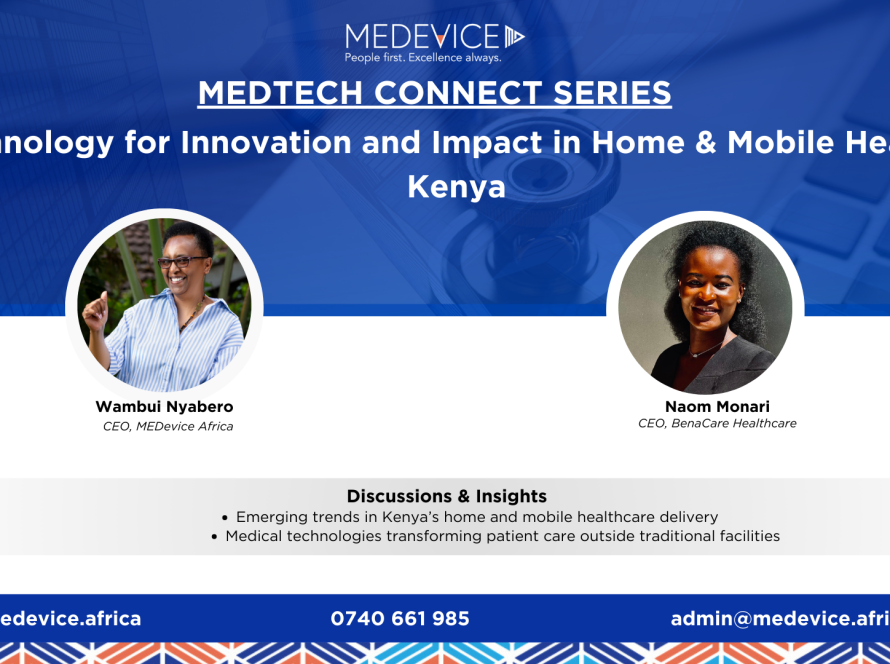
The path to successful medical technology (MedTech) innovation in Kenya has been a difficult one, with few solutions making it past the prototype stage. That narrative is currently being rewritten. A recent webinar hosted by MEDevice Africa discussed the findings of a pilot study, highlighting the practical, and evidence-based frameworks developed to respond to the realities of the local healthcare system.
“The purpose of this study is not to design products, but to understand how we prioritise needs, [hospital] departments and [healthcare] solutions so that innovation is driven by impact.” (Wambui Nyabero, Principal Investigator)
The researchers set out to understand how to use structured frameworks to clearly define the weightiest healthcare needs and then to use ecosystem realities to identify which potential solutions were both clinically impactful as well as commercially viable. Additional work needs to be done to expand the study to ensure that the data is nationally representative. However, a multi-disciplinary gathering of healthcare ecosystem stakeholders validated that the results were directionally appropriate.
Dr. Watu Wamae emphasized the need for a mind-shift towards understanding the market by moving from “chasing the market” to creating a “vortex of demand.” Too often, innovations are developed in isolation, with technologies built first and markets considered later. In many cases, this leads to solutions that struggle to find adoption.
Clinical immersion for innovators is a must-have, so they can observe workflows, identify bottlenecks and breakdown points, and understand user experience. It is not enough to know that dialysis is needed; it is equally important to understand whether machines are functional, whether staff can operate them efficiently, and what constraints exist around their use. Innovation should begin where there is both clear clinical value and financial viability, and it must be designed with scalability in mind from the start.
An unintended bonus of the research was that the needs-fit methodology, that provided a prioritisation of hospital departments and a list of needs statements, could be immediately useful for individual hospital or county health technology planning purposes.
MedTech innovation in our local context happens within what can be described as institutional voids. An example is regulatory systems that are still evolving, which creates a challenge. In the absence of strong local validation frameworks, Innovators often have to rely on international regulatory systems which are costly in both time and capital.
However, it was pointed out that rather than waiting for systems to mature, innovators could actively engage with the ecosystem; working with regulators such as the Pharmacy and Poisons Board (PPB) and contributing to the development of standards that would ultimately support local innovation.
While the pilot study across four hospitals provides a strong foundation, it is only the beginning. For this framework to have lasting impact, it must be expanded across multiple counties to reflect the diversity of Kenya’s healthcare landscape and to test what can truly scale.
Look out for a report based on the research findings in the coming months and prepare to engage deeply in the expansion of these ideas. Because ultimately, building a sustainable MedTech ecosystem in Kenya will not come from isolated ideas, but from passionate changemakers developing solutions that are grounded in context, shaped by the system, and designed to work within it.